


Hello Tron Dancers,
You probably know, we have been working on a pixel suit for some time. To be honest, it was not an easy task at all! It took us a quite long time but there is a reason – we just wanted to create something further away from what our competitors have done so far.
Our main goal was to create a fully synchronized LED pixel suit, precisely working with music, so you can always rely on it, and on top of this all we aimed to make it easy to work with. Now, you are maybe asking yourself: ‘Is this something that hasn’t been created by our concurrency so far?’ Yes, it is, and I will explain to you why:
A lot of LED groups are using pixel costumes but their main problem is that it is not fully synchronized with the show. They make effects but the potential of the costume is not fulfilled for sure. Another problem is, the movement in the suit is usually super restricted, so it is almost impossible to make a proper dance show.
Before you read the article, sit back and enjoy the result:
What was the hardest part to do?
While we were making the pixel costume, we needed to go through many important decisions. Here are the main ones:
Visual perspective:
Skeleton
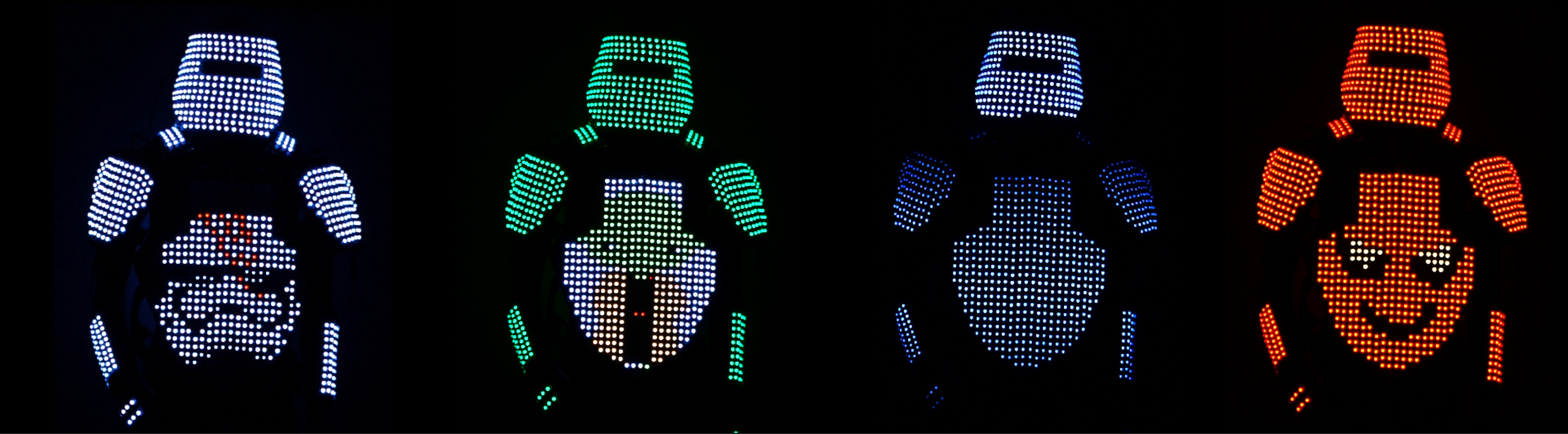
This is the first question, you need to ask yourself. Where to place the LEDs? You need to find a material that is tough enough, not too bendy so you can fix LEDs properly but at the same time, it cannot be too hard so the dancers can move. We have bought and tried multiple types of possible costume skeletons to find the correct one. When we found it, another thing to discuss was, what can be used for the head and legs. We picked materials that we had experience with, but anyway it was a lot of work with cutting the plastic and drilling the right holes for additional CVB boards (that will stick to plastic). For the legs, we have used the same shape as for classic Tron Dance suit has, we just made them bigger, so have more space for LEDs. The shoes needed some better solution than the system we use for all other costumes because we already have 3 types of LED shoes and you can imagine how many pairs of shoes it is when you need to store many sizes of these shoes for all dancers who dance in our team. So we have created a ‘shoe cover’, which you can put on your shoes with a simple rubber band.
LED quantity VS movement freedom
Do you prefer LED to have everywhere and transform the dancer to the LED wall? Or, you want to have a nice costume with the ability to dance? Many people write me emails, where they want to install around 3000 – 4000 pixels on their costume. I would also love to have so many LEDs on the suit, but the problem is that no one could move in this costume. If you don’t allow the dancers to move you can’t expect them to create a breath-taking show full of crazy dance moves. So, the question is, do you want a dance show or static LED Wall that can barely move? In our suits, we have used 1721 pixels what is 28 meters of LED strips, what is the right balance for us to reach the best of both worlds.

In this blog we summed up everything from visual perspective. In the next blog we will go through the hardware point of view. If you already have some questions contact us here and we will be happy to answer.